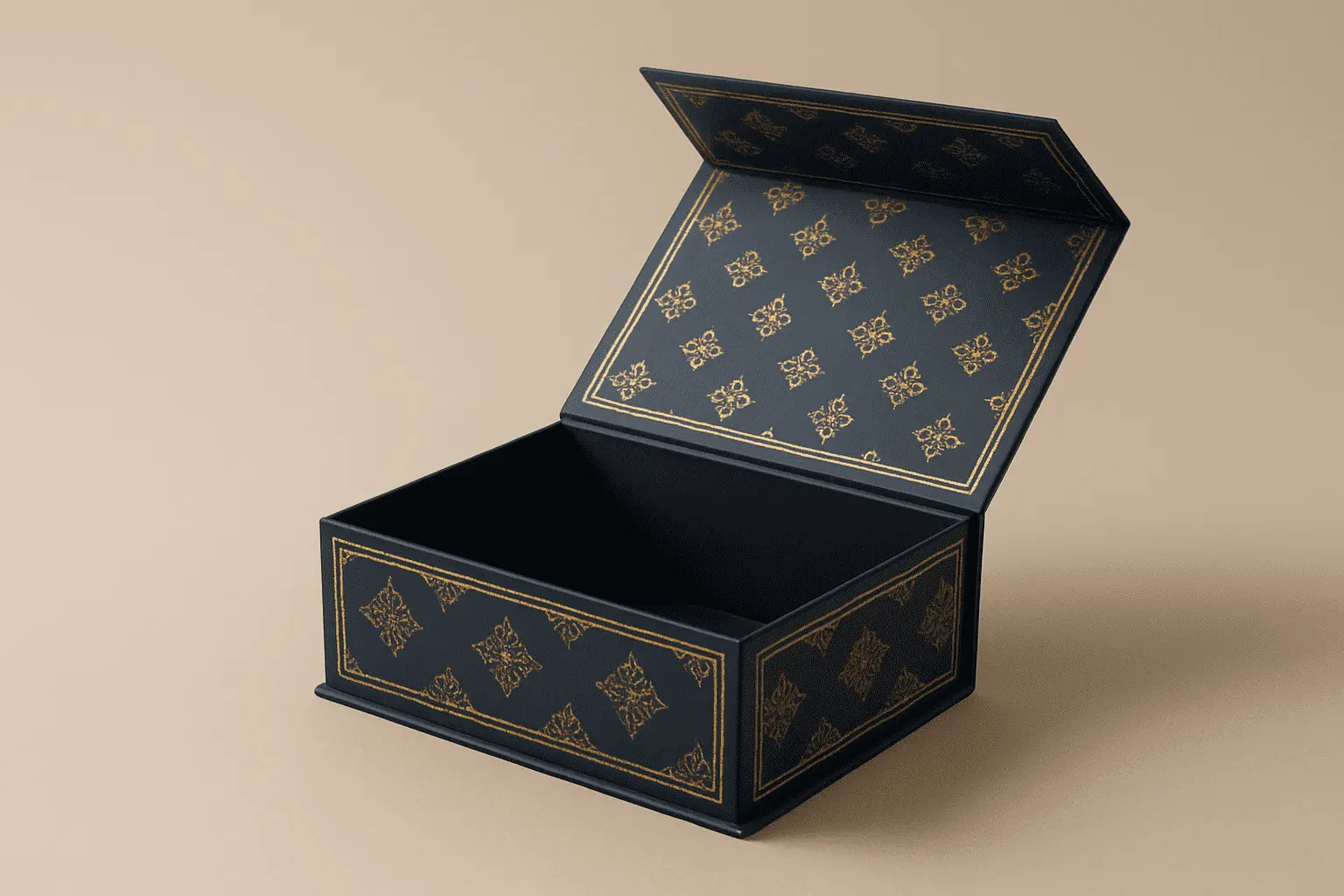
What is a rigid box? Difference folding carton and rigid box?
A rigid box is a premium packaging solution constructed from thick paperboard wrapped around a solid chipboard core, offering exceptional structural integrity and a luxurious presentation that elevates brand perception. Unlike standard folding cartons that collapse flat, traditional rigid boxes maintain their form, providing superior product protection and an impressive unboxing experience. The emerging foldable rigid box combines these premium qualities with a collapsible design, delivering both elegance and logistical efficiency for cost-conscious brands seeking differentiation in competitive markets.

What Is a Rigid Box? Definition and Key Characteristics
There are several types of packing, but rigid boxes are the best because they are strong and look amazing. Thick chipboard or dense paperboard, usually between 2mm and 5mm thick, is used as the base for these boxes. They are then wrapped in colorful paper or other materials. Carefully wrapping the printed cover material around a hard board base is part of the manufacturing process. This makes a physically stable container that keeps its shape over time.
Construction and Material Specifications
The choice of base material is what makes a hard box work. High-density chipboard is used for the structure, and art paper, textured specialty papers, fabric, leather, and shiny foils can be used for the wrapping. This two-layer design is strong and can look good in a variety of ways. Precision glue methods are often used to attach covering materials to the rigid base, so there are no obvious seams or glue lines during the assembly process.
Structural Variations and Design Options
There are different structural designs for rigid boxes, and each one is best for a different set of appearance and function needs. The different lids and bottoms of telescopic designs are reminiscent of the classic shoe box design. This makes them easy to open and stack. Sleeve-style boxes have an outer shell with a moving tray inside. This creates a stacked reveal effect that makes the items seem more valuable.
Premium Finishing Techniques
By treating the outside, hard boxes can become brand champions. Offset lithography is used to get accurate color copy, screen printing is used for special inks, and digital printing is used for short runs with changeable data. Post-press improvements like foil stamping, embossing, debossing, and spot UV coating give goods more visual and physical depth that makes them stand out on store shelves that are already full.
Folding Carton vs. Rigid Box: Core Differences Explained
When procurement workers know the main differences between rigid and folding cartons, they can make choices that are in line with product needs, budget limits, and brand positioning strategies.
Material Composition and Structural Design
Folding boxes are made from single-layer paperboard that is usually between 12pt and 24pt thick. They are die-cut and scored so that they can fold flat for easy shipping and storage. They are put together by carefully folding and sticking two-dimensional pieces together to make three-dimensional shapes. Because they are so light, folding boxes are cheap for high-volume uses because they save money on both material costs and shipping costs.
Durability and Protection Characteristics
Stress testing makes the difference in performance between fixed and folded cartons clear. Folding boxes protect fairly durable goods well in controlled distribution settings, but they may get creased or damaged at the corners if they are handled roughly. Their smaller walls don't offer much protection against collisions.
Cost Considerations and Value Proposition
Folding cartons usually cost 40 to 60 percent less than similar stiff boxes because they are easier to make and use less material. Because they come flat-packed, they take up a lot less space in shipping containers, which can hold a lot more units than hard boxes that have to be put together. Because of these things, folding boxes are good for items that are competing mostly on price or don't need to be very different from each other.
The Hybrid Solution: Foldable Rigid Box Advantages
Foldable rigid box technology is a middle ground between rigid boxes and folding cases. It has strong benefits for buying teams that have to handle many tasks at once. The sleek look and strong construction of these new structures are similar to traditional rigid boxes, but they have foldable designs that cut shipping costs by 60–80%.
The construction uses reinforced edges and complex folding mechanisms that let the box fold flat after being put together and then straighten back up without any obvious creasing or structural weakness. This engineering feat combines the looks and safety of rigid boxes with the ease of operations of folding cartons, making a perfect solution for brands that want to show their products in the best way possible without having to pay too much for shipping.
Introduction to Foldable Rigid Boxes: Innovation in Packaging
Foldable rigid box solutions are a major advancement in luxury packing technology, resolving the long-standing conflict between presentation quality and supply chain effectiveness. These complex structures use high-quality materials and precise engineering to make packaging that is both strong and easy to fold up.
Engineering and Manufacturing Process
To make Foldable rigid boxes, you need special tools and better ways to make things than what a regular rigid box can do. The initial step involves carefully die-cutting cardboard parts with strategic scoring patterns that allow controlled folding without affecting the structural integrity. Covering materials are treated the same way, with scores that are perfectly lined up with the fold lines on the boards.
At Fetching Printing, our facilities use cutting-edge die-cutting technology and automatic building systems that are set up to make Foldable rigid boxes. Our engineering team has come up with their own scoring patterns and ways to strengthen parts that make them last longer while still keeping the high-end look that luxury brands want.
Logistics and Cost Benefits
The main benefit of Foldable rigid boxes is that they make handling easier. Traditional stiff boxes ship in their fully built state, taking up a lot of storage space and truck space for their weight. Depending on its size, a normal shipping container could hold between 2,000 and 3,000 hard boxes that have been put together.
Efficiency improvements in warehousing are just as important. Collapsed boxes stack well on standard crates, which increases the amount of space available vertically and makes managing goods easier. Co-packers and distribution centers like the extra room because it saves them money, which they often pass on to brands through lower storage fees.
Application Across Industries
Foldable rigid boxes are popular in many fields, each taking advantage of the format's own benefits. Cosmetics companies use them to package high-end skincare sets and fragrances in gift sets, where the cost of the better appearance is justified by the savings in shipping. Having the option to use glass panels, shaped trays, and magnetic closures makes it possible to make complex displays that increase sales in competitive beauty stores.
Foldable rigid boxes are being used by subscription box services as an eco-friendly option to standard packing. The foldable design saves them money on shipping while still giving customers the high-quality experience they expect. They are used by high-end stores for limited versions and seasonal campaigns, where the unique wrapping makes the items seem more special without having to keep a stock of big boxes all the time.
How to Choose Between Rigid Box, Foldable Rigid Box, and Folding Carton
To choose the right package, you have to carefully look at a lot of different factors and find the balance between the needs of the product, the limitations of your business, and your goals for market positioning.
Product Characteristics and Protection Requirements
First, look at how fragile the product is, how much it weighs, and what its dimensions are. Things that are fragile and need a lot of padding do better in rigid boxes, while long-lasting things may do fine in folding cases. Think about what the product's value offer is and what the target audience expects from the presenting quality.
Brand Strategy and Market Positioning
Look at how other companies in your area handle packing. If you match or beat the quality of competitive packages, you won't be at a loss at the point of sale, and if you use unique structural designs, you can stand out. When brands move into the premium market, they often need to improve their packaging to gain the trust of their target audiences.
Supply Chain and Logistics Analysis
Find the total landed costs, which include making the packing, shipping, storage, and handling for delivery. Foldable rigid boxes often have lower costs when looked at as a whole, even though they cost more per unit than folded cases. Especially for foreign supply lines, the savings in transportation often make up for the higher cost of production.
Sustainability Considerations and Certifications
As customers and retailers expect more sustainable practices, environmental duty plays a bigger role in the choices that are made about packaging. Check how much of the material can be recycled and what the choices are for getting rid of it when it's no longer useful. When recovered paperboard and water-based adhesives are used to make folding crates and rigid boxes, they can both have great green ratings.
Supplier Evaluation and Partnership Criteria
Choosing the right supplier has a big effect on the quality, dependability, and total cost of ownership of the package. Check out possible partners' production skills, quality control systems, and technical help resources. When it comes to improving structure designs and manufacturing processes, manufacturers with a wide range of tools are more useful.
Purchasing and Procurement Guide for Foldable and Rigid Boxes
To successfully buy premium packaging, you need to know what the provider can do, set clear requirements, and put in place quality assurance procedures that protect the identity of your brand.
Minimum Order Quantities and Pricing Structures
Setting up die-cutting tools, stamping plates, and machines for rigid and Foldable rigid box production costs a lot of money. Manufacturers usually set minimum order amounts that spread these fixed costs out over a large enough number of units to get fair prices. Depending on the complexity of the structure and the level of finish needed, standard MOQs are between 1,000 and 5,000 units.
With volume price tiers, the cost per unit goes down as the quantity ordered rises, which encourages bigger commitments. When brands release new products, they have to balance reducing the risk of having too much inventory at the start with getting good prices. Some makers offer split shipments, which means they make full loads to get better prices on bulk and send parts on different dates to keep track of cash flow and warehouse space.
Customization Options and Design Collaboration
Custom sizes, glass panels, shaped trays, ribbon ties, or magnetic systems are some examples of structural changes that can be made. Each part adds difficulty and costs that providers should be clear about. Different makers have very different printing options. Some only offer basic offset printing, while others offer more advanced methods like gold pressing, embossing, and metallic paints.
Before committing to production, ask for physical examples that show the necessary skills. Check the quality of the building, the accuracy of the finishing, and the general craftsmanship. Samples tell you a lot more about a manufacturer's skills than pictures or specs alone. At Fetching Printing, our experienced R&D team of packaging engineers works with clients throughout the design development process. They help with choosing the right materials, making sure the structure is optimized, and making sure the product can be made.
Quality Assurance and Production Monitoring
Structured quality assurance procedures protect against mistakes in production that cost a lot of money and delays in delivery. Set up review points at different stages of the manufacturing process. Start with digital copies to make sure the artwork is correct and meets color requirements. Before full production starts, pre-production models show how the structure is put together and finished.
Manufacturers with strong quality management systems use statistical process controls and regular testing methods to find differences before they affect shipments to customers. Fetching Printing's ISO9001-certified processes include multiple inspection points throughout production to make sure that all finished packaging regularly meets client needs and standards.
Lead Times and Production Scheduling
Realistic wait times help with production planning and keep you from having to pay expensive rush fees or run out of stock. It usually takes 20 to 30 days to make rigid boxes from the time that the samples are accepted until the finished goods are ready, but longer times may be needed for complicated designs or special materials. Due to their intricate construction, Foldable rigid boxes frequently need the same or slightly longer wait times.
Set up regular ways to talk to your suppliers and ask for information on the state of your projects at key points. Proactive makers let customers know about possible delays early enough so that they can look into ways to avoid them. This keeps things clear, which helps with planning.
Conclusion
When choosing between rigid boxes, standard folding cartons, and new Foldable rigid box solutions, you have to think about how to protect your products, how to place your brand, and how to keep the supply chain costs low. Rigid boxes give luxury and high-value items an unbeatable high-end look and protect the structure, which improves how people think of the brand. Folding boxes are a cost-effective and easy-to-handle way to ship long-lasting things in competitive markets. Foldable rigid boxes are a great combination option because they look like rigid boxes but are much better at shipping, which lowers the total cost of ownership. For buying to go well, suppliers must be carefully evaluated, with a focus on their ability to manufacture, quality certifications, and support for joint design. Brands that see packaging as a strategic advantage for their brand can benefit from working with experienced makers who can provide technical know-how and a dedication to quality throughout the lifecycle of the product.
FAQ
What makes foldable rigid boxes different from traditional rigid boxes?
Foldable rigid box structures are made using special methods that let them be flattened for shipping and storage and then inflated to their full rigid size when they are needed. Traditional rigid boxes have a fixed three-dimensional shape, which means they take up a lot more room in the supply chain. Both give a great look and strong defense, but foldable models are 60–80% cheaper to ship because they use space more efficiently.
Can rigid boxes be customized with windows, inserts, and specialty finishes?
Premium rigid boxes can be customized in many ways, such as with clear window panels to show off the product, foam or paperboard inserts to keep the contents safe, magnetic latches, ribbon pulls, and special finishes like silver printing, embossing, soft-touch coatings, and metallic papers. These improvements help brands stand out and create opening experiences that people will remember, which gets them to interact with the product and share it on social media.
How do I determine whether rigid boxes justify their higher costs?
Analyze total value proposition, including product protection, brand perception impact, and customer experience enhancement. Products with high margins, luxury positioning, or gift-giving applications typically justify premium packaging investments. Calculate complete supply chain costs, as Foldable rigid box solutions often deliver savings through logistics efficiency that offset higher per-unit production costs compared to folding cartons.
Partner With Fetching Printing: Your Trusted Foldable Rigid Box Manufacturer
Choosing the right packaging partner determines whether your investment delivers maximum brand impact and operational efficiency. Fetching Printing has been making high-quality Foldable rigid box solutions for 25 years. They use cutting-edge production technology and have a lot of experience in the cosmetics, electronics, luxury goods, and e-commerce industries. Our ISO9001 and ISO14001 certifications, along with our G7 color management and FSC sustainability badges, give foreign names the peace of mind and environmental responsibility they need.
Email our packing experts at public@fetchingprinting.com to talk about your unique needs and ask for sample kits that show how our Foldable rigid boxes can be used. We'd love the chance to help your brand succeed by providing you with high-quality packing options that make your products look better and make your supply chain run more smoothly.
References
1. Robertson, Gordon L. "Packaging Materials and Structures for Premium Consumer Products." Journal of Applied Packaging Research, vol. 12, no. 3, 2020, pp. 145-167.
2. Klimchuk, Marianne Rosner, and Sandra A. Krasovec. Packaging Design: Successful Product Branding From Concept to Shelf. 2nd ed., John Wiley & Sons, 2021.
3. Soroka, Walter. "Rigid Box Construction and Engineering Standards." Fundamentals of Packaging Technology, 6th ed., Institute of Packaging Professionals, 2019, pp. 289-312.
4. European Federation of Corrugated Board Manufacturers. "Comparative Analysis of Rigid Packaging Structures: Performance and Sustainability Metrics." Technical Report Series, 2022.
5. Chen, David S., and Patricia Williams. "Cost-Benefit Analysis of Collapsible Rigid Packaging in Global Supply Chains." International Journal of Logistics Management, vol. 31, no. 4, 2021, pp. 523-541.
6. Sustainable Packaging Coalition. "Material Selection Guide for Premium Rigid Packaging Applications." Industry White Paper, 2023.

Based on your location and order quantity, you will have the opportunity to receive a limited time free shipping promotion!

Corporate Purpose