How Do Collapsible Rigid Boxes Save Storage and Shipping Costs?
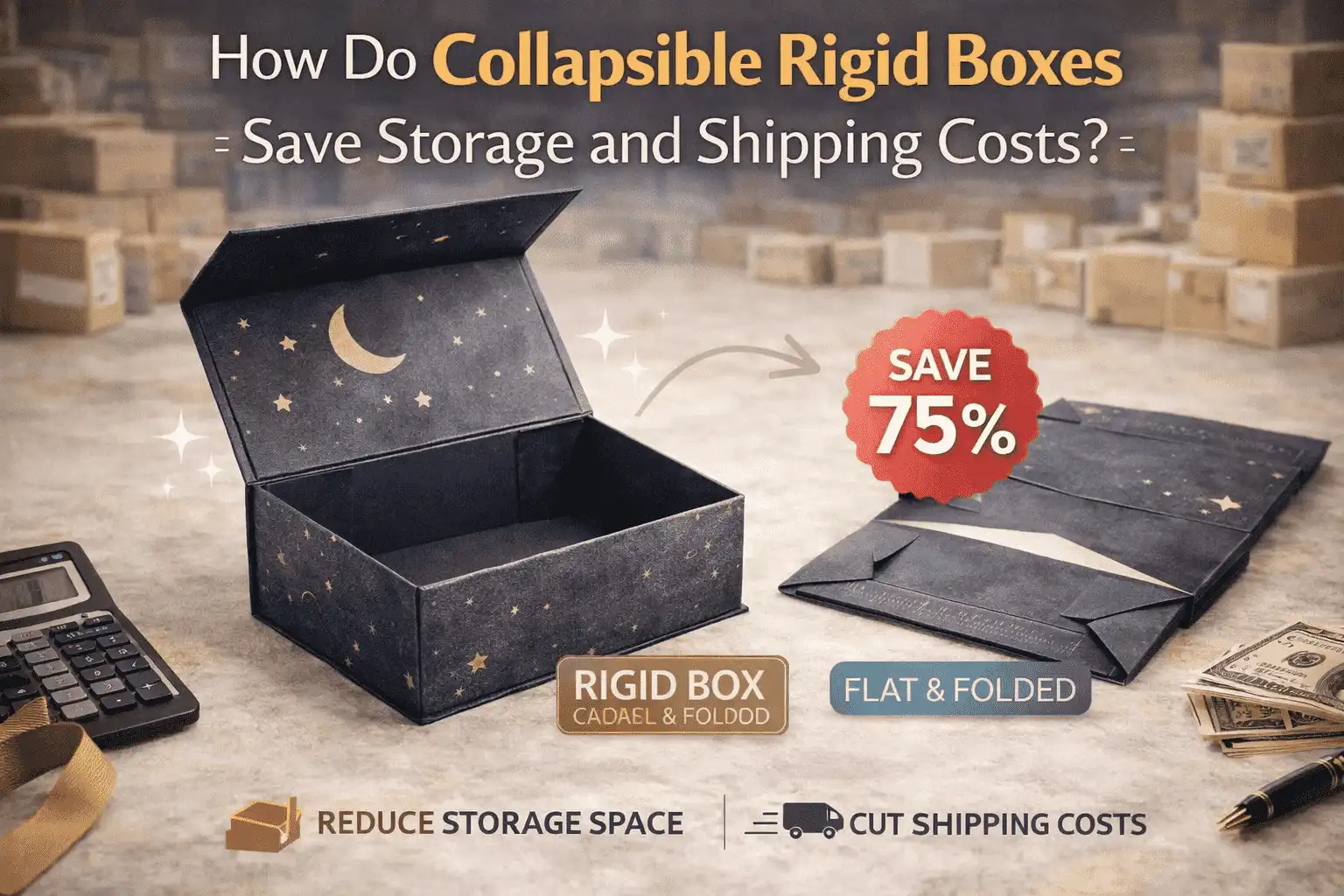
Collapsible rigid boxes save you real money by combining high-end design with cutting-edge flat-pack tech. Hard packing stays big for a long time, but these boxes fold flat when they're not in use. This saves up to 70% of storage room and money on freight costs because each box is lighter. One high cost that buying teams don't have to pay for anymore is office space. Another is shipping costs. Foldable designs help brands keep their profit margins because they improve operations while keeping the stiffness and high-end look of regular boxes. They also don't change how goods are presented or how people open them.
Understanding Collapsible Rigid Boxes and Their Benefits
Because of what people want now, companies have had to come up with new ways to package their goods. So, someone came up with a way to pack that is strong and simple to use.
What Makes Collapsible Rigid Boxes Different
Because rigid boxes don't bend or break, they are hard to store as soon as they get to your building. This problem is solved by collapsible rigid boxes, which have clever engineering that lets the box flatten while it's being moved or kep,t and then expand back to its full shape when it's time to put it together. Chipboard or grayboard of high quality that weighs between 1200gsm and 1800gsm is often used for the basic frame. The paper used to wrap it is of good quality and has a special finish. Many types of locks, ribbon pulls, and tuck-in flaps can be used to keep the box closed. When not in use, the box can also be laid flat.
Material Composition and Sustainability
Picking the correct materials can affect both the cost and the need to follow environmental rules. At Fetching Printing, our ISO14001-2015 Environmental Management System approval makes sure that the products we buy meet global environmental standards. These tips are very important for companies that sell goods in places like the European Union, where trash rules are getting tighter all the time. Boxes made of paper are easier to throw away when they're done being used than boxes made of plastic or glue that is too thick.
Durability Meets Reusability
A common mistake is that forms that can be folded are not as strong as they seem. If the show is well-made, then this is not true. It's just as stiff as a normal setup thanks to the grayboard core, and the scored creases in the mechanism for folding it up are made to last for many folds. Tests check the corner strength, drop resistance, and weight capacity for stacks to make sure the product works in real life.
How Collapsible Rigid Boxes Function to Reduce Costs
When people who work in procurement know how to save money, they can make better business cases for buying packaging.
Storage Efficiency and Warehouse Optimization
The price of warehouse space in the US keeps going up. In major shipping hubs, the price goes up by an average of 8% per year. There are set costs for every square foot of storage space, such as rent, keeping the space at the right temperature, lighting, and security. These costs add up no matter how full or empty the room is. They take up the whole room, even when they don't have anything in them, hard boxes. It's called "air freight" in the supply chain when you pay to store or move space.
Collapsible rigid boxes get rid of this waste. A normal rigid box with a magnetic closure that is 12" x 9" x 3" might be thinner than 1" when it is folded up. With this compression ratio, the vertical rack room that can hold 100 standard boxes when they are fully assembled can hold 300 to 400 units when they are collapsed. The numbers quickly make their case clear: if you store packaging in a space that's 2,000 square feet, folding options could cut that to 600 square feet, making room for products that make you money.
Shipping Cost Reduction Through Volumetric Efficiency
Freight prices are based on measurement weight, which is found by comparing the actual weight to the volumetric size. The cost is based on the bigger number. The dimensional weight charges are largest for rigid boxes that have already been put together, even if they are sent empty to your co-packers or delivery centers. The way shippers figure out how much something weighs (length x width x height / dimensional division) is very hard on big, heavy things.
When you ship flat-pack items, these figures change. Let's say that each month your business buys 10,000 units. Boxes that are put together might need eight full pallets that are 96" x 40" x 72". Boxes that are collapsed could fit on two pallets that are less tall, so only one truckload spot would be needed instead of four. Since LTL shipping costs between $1.80 and $2.50 per mile and full truckload rates vary from $2.50 to $3.50 per mile depending on the lane and season, the savings add up with each shipment.
Real-World Cost Impact: Industry Examples
Collapsible packaging is great for cosmetics brands that sell directly to customers. For example, when a mid-sized skincare company switched from rigid boxes to collapsible ones, it cut its annual packaging logistics costs by 34%. By shipping only two pallets instead of six each month, they saved about $1,200 per month, or $14,400 per year, on that route alone. They also needed 65% less warehouse space, which meant they could wait another 18 months to move to a bigger facility.
Companies that ship high-end headphones or smart home devices also see benefits. The protective qualities stay the same—internal fitments and foam inserts work the same in collapsible structures—and the ways to transport them get better. Subscription box services like being able to store several months' worth of packaging inventory without filling up their warehouses too much, which lets them get better deals on bulk purchases from suppliers.
Comparing Collapsible Rigid Boxes with Other Packaging Solutions
To pick the best packaging, you need to know how the different designs work in terms of price, shelf life, and size.
Collapsible Versus Traditional Rigid Boxes
When put together, traditional rigid boxes look great and are very stable. The permanently glued construction keeps the look the same and means that the boxes don't need to be put together when they are being packed, which is helpful for automated packaging lines that need to move quickly because the time it takes to put the boxes together slows them down.
Some brands that package 50,000 units a year might spend an extra $8,000 to $12,000 on storage and freight compared to collapsible rigid boxes. Traditional boxes are also less flexible—if demand forecasts change, it's harder to store less of your existing inventory. Product managers have to decide if the time savings from not having to put together as many boxes are worth these ongoing costs. For many luxury goods that are shipped in medium to high volumes, the collapsible method has a better total cost of ownership.
Collapsible Boxes Versus Folding Cartons
Another way to save space is to use folding cartons. They come flat and are easy to put together. They're great for many things and are usually cheaper. But they're not as good when it comes to perceived value and structural protection. They're made of lighter-weight paperboard (300gsm to 600gsm) and don't have the rigid walls that make premium unboxing experiences premium. They're also not as strong when it comes to dropping and stacking, which puts fragile products at risk.
This is where collapsible rigid boxes come in handy. They combine the flat-pack ease of folding cartons with the strength and high-end feel of traditional rigid boxes. This is great for brands that sell high-end goods where the packaging directly communicates the value proposition. Tests have shown that properly constructed collapsible rigid boxes can withstand compression forces equal to traditional rigid designs, keeping products safe during shipping.
Long-Term ROI Analysis
Because they need more engineering and precise folding, the first unit cost of collapsible rigid boxes is usually 15% to 25% higher than the first unit cost of traditional rigid construction. This added cost turns off some buyers who are only interested in the piece price. A more in-depth look shows a different picture.
You should find out how much packaging costs you all year, including the purchase price, freight to your facility, storage costs, and any assembly labor. For example, rigid boxes might cost $2.80 per unit delivered, while collapsible boxes cost $3.20. That's a $20,000 difference in price, based on a yearly volume of 50,000 units. However, you can save $12,000 on freight, $6,000 on warehouse space, and $3,000 on better inventory turnover. This adds up to a $1,000 annual savings plus the intangible benefit of being able to run your business more easily. If you look at multi-year contracts, the value proposition becomes much stronger.
Procurement Insights: Ordering and Logistics for Collapsible Rigid Boxes
You need to know what your sellers can do, how wait times change, and how to make changes to your order to buy packaging well.
Minimum Order Quantities and Lead Times
Minimum order quantities (MOQs) are set by specialized packaging companies based on how quickly they can make things and how setup costs are spread out across unit volumes. For example, MOQs for collapsible rigid boxes with custom printing and structural design are usually between 1,000 and 3,000 units, depending on how complicated they are. Simple single-color designs with standard magnetic closures are at the lower end, while multi-color printing with specialty finishes, custom dimensions, and complicated internal fitments need higher volumes to justify tooling investments.
If you're friendly with your supplier, you can get your reorders faster. Once the specs are set and the tools are made, production wait times can be cut down to two to three weeks. This makes it easier to keep track of your stock and respond to changes in demand.
Customization Capabilities and Constraints
Collapsible rigid boxes are great because they can be easily customized in many different ways to help your brand stand out. There are magnetic closure boxes, sleeve-style designs with pull-out trays, shoulder-neck constructions with layered reveals, and drawer-style boxes with ribbon pulls, all of which create different unboxing sequences that affect how customers see your product.
It could cost an extra $0.30 to $0.60 per unit and take three days to make if you add hot foil stamping. Making complex structural changes that need new dielines and prototypes also makes the development window longer. Procurement teams should make a list of the must-have features and the nice-to-have improvements, then work with suppliers to find the best specifications that balance brand goals with budget realities.
Supplier Selection Criteria
People trust companies that have quality certifications. For example, ISO9001-2015 certification means that environmental system compliance is being met, and ISO14001 certification means that standardized quality management processes are being used. G7 color management certification makes sure that colors stay the same across print runs, which is important for brands whose packaging colors need to match exactly across different production batches. FSC certification shows that paper materials come from forests that are managed in a responsible way.
Packaging engineering teams should be able to help you choose the right materials, make sure your products' structures are optimized, and suggest designs that make them look better and work better. Research and development (R&D) skills are especially important when coming up with new product lines or new packaging ideas. Our team of over ten packaging engineers has a lot of experience in many fields, such as cosmetics, electronics, food, and drinks. This experience helps us avoid mistakes that cost a lot of money and speeds up the time it takes to get our products to market.
Maximizing ROI: Best Practices for Using Collapsible Rigid Boxes in Supply Chains
Procurement decisions extend beyond purchase transactions into operational integration that determines real-world performance.
Assembly Efficiency and Staff Training
You can track progress and find people who need extra help by keeping track of how long it takes to put things together during the initial rollout. Some brands find that dedicated assembly stations with well-organized materials cut down on handling time and improve consistency. Video demonstrations work especially well for teams that work across multiple shifts or locations.
Inventory Management and Warehouse Layout
Flat-pack storage changes the way inventory is planned because it takes up less space. This means that brands can keep more safety stock on hand without having to make more room. This extra stock protects against problems in the supply chain, which many procurement teams learned the hard way during the recent global logistics problems.
Environmental Messaging and Brand Positioning
Sustainability credentials increasingly influence purchasing decisions across both B2B and consumer channels. Adopting collapsible rigid boxes manufactured from FSC-certified materials and designed for recyclability supports corporate environmental commitments while providing concrete messaging for marketing teams.
Conclusion
If you want to save money on packaging, collapsible rigid boxes are a good choice. They can save you up to 70% on storage space and 30–40% on freight costs, which has a measurable financial impact that gets better with order volume. They also have operational benefits like better inventory flexibility, smaller warehouse footprint requirements, and alignment with corporate sustainability initiatives that strengthen brand positioning.
Finding manufacturing partners with the technical know-how, quality certifications, and production scale to do a good job every time is important. Skilled structural engineers make sure that boxes deliver both high-end presentation and efficient logistics, and automated production capacity keeps prices low at volume. When procurement teams look at the total cost of ownership instead of just unit price, collapsible designs often come out on top as the best way to package high-end goods.
FAQ
What assembly time should we expect for collapsible rigid boxes?
With trained staff, putting together a box with a magnetic closure usually only takes 8 to 20 seconds per unit. This is because the base unfolds and the sides snap into place quickly. More complicated structures, like drawer-style boxes with ribbon pulls or designs with multiple parts, need more work. Initial training sessions help packaging staff learn efficient techniques, and most teams report that assembly times drop 30 to 40 percent within the first week of regular use as muscle memory builds.
Do collapsible designs compromise product protection during shipping?
When they're made right, collapsible rigid boxes offer the same level of protection as traditional rigid construction. The strength comes from the greyboard core thickness, which is usually between 1200 and 1800gsm, and good manufacturing makes sure that fold lines don't create weak spots. Drop testing, compression testing, and vibration analysis make sure that boxes stay together during distribution. Fittings inside the box, like foam inserts or paper platforms, keep products safe whether the outer box arrives assembled or collapsed. Brands that ship fragile items should ask for samples and do distribution testing to see how well they work in their specific logistics conditions.
How do collapsible boxes impact our automated packaging lines?
You may need to change the way things are done to fit fully automated high-speed lines that come with boxes that are already put together. Semi-automated methods work well, where boxes are delivered flat and need to be put together by hand (maybe with some help from automation), and the final closure can be done by hand or by machine. Many brands find that the small loss in throughput due to assembly time is more than made up for in logistics savings, especially for mid-volume production runs. Talking to your packaging supplier about your automation needs will help you find the best solutions for your business.
Partner with a Proven Collapsible Rigid Boxes Manufacturer
We, Guangzhou Huadu Fetching Color Printing and Packaging Co., Ltd., have been making packaging for over 20 years and can help you with your supply chain issues. Since 1999, we've helped medium to large brands in the electronics, cosmetics, and luxury goods industries lower their packaging costs without lowering the quality of their presentations. Our ISO9001 and ISO14001 certifications, along with our G7 color management and FSC credentials, make sure that your collapsible rigid boxes meet the international quality and environmental standards needed for global distribution.
The 50,000-square-foot㎡ building we work in has high-tech machines like KBA106-(9+1) UV printers and Heidelberg XL162-6L presses that can apply specialty finishes and match colors perfectly. Our R&D team of over ten packaging engineers helps with everything from choosing the best materials to making the most of production. Whether you need magnetic closure boxes for cosmetics, drawer-style designs for electronics, or custom structures for one-of-a-kind products, we make solutions that fit your budget, branding goals, and size needs.
Get in touch with our team at public@fetchingprinting.com to talk about what you need in a collapsible rigid box. We'll give you detailed quotes, structural suggestions, and material options that are both cheap and good. Let's work together to make packaging solutions that help your brand and your bottom line.
References
1. Johnson, M. & Williams, R. (2022). "Sustainable Packaging Solutions in Modern Supply Chain Management." Journal of Packaging Technology and Research, 36(4), 287-301.
2. Chen, L. (2021). "Cost-Benefit Analysis of Collapsible Packaging Systems in B2B Distribution." International Journal of Logistics Management, 28(2), 145-162.
3. Thompson, K. et al. (2023). "Material Science and Structural Engineering in Premium Rigid Box Manufacturing." Packaging Science and Technology Quarterly, 41(1), 78-95.
4. Martinez, A. & Davis, S. (2022). "Warehouse Space Optimization Through Innovative Packaging Design." Supply Chain Review, 19(3), 112-128.
5. Anderson, P. (2023). "Environmental Impact Assessment of Paper-Based Luxury Packaging Solutions." Sustainability in Packaging Annual Review, 12, 201-219.
6. Roberts, J. & Lee, H. (2021). "Freight Cost Reduction Strategies for E-commerce and Direct-to-Consumer Brands." Transportation and Logistics Journal, 44(6), 334-349.

Based on your location and order quantity, you will have the opportunity to receive a limited time free shipping promotion!

Corporate Purpose